
Neuquén's Pinot Noir: Patagonia's Emerging Expression of Elegance
An in-depth look at one of Argentina's most distinctive cool-climate wine expressions.
By Sergio Landoni, Territory-Based Sommelier
An expanded perspective on Patagonian Pinot Noir by Sergio Landoni was published by The Buyer , the UK wine trade publication, on August 25, 2026.
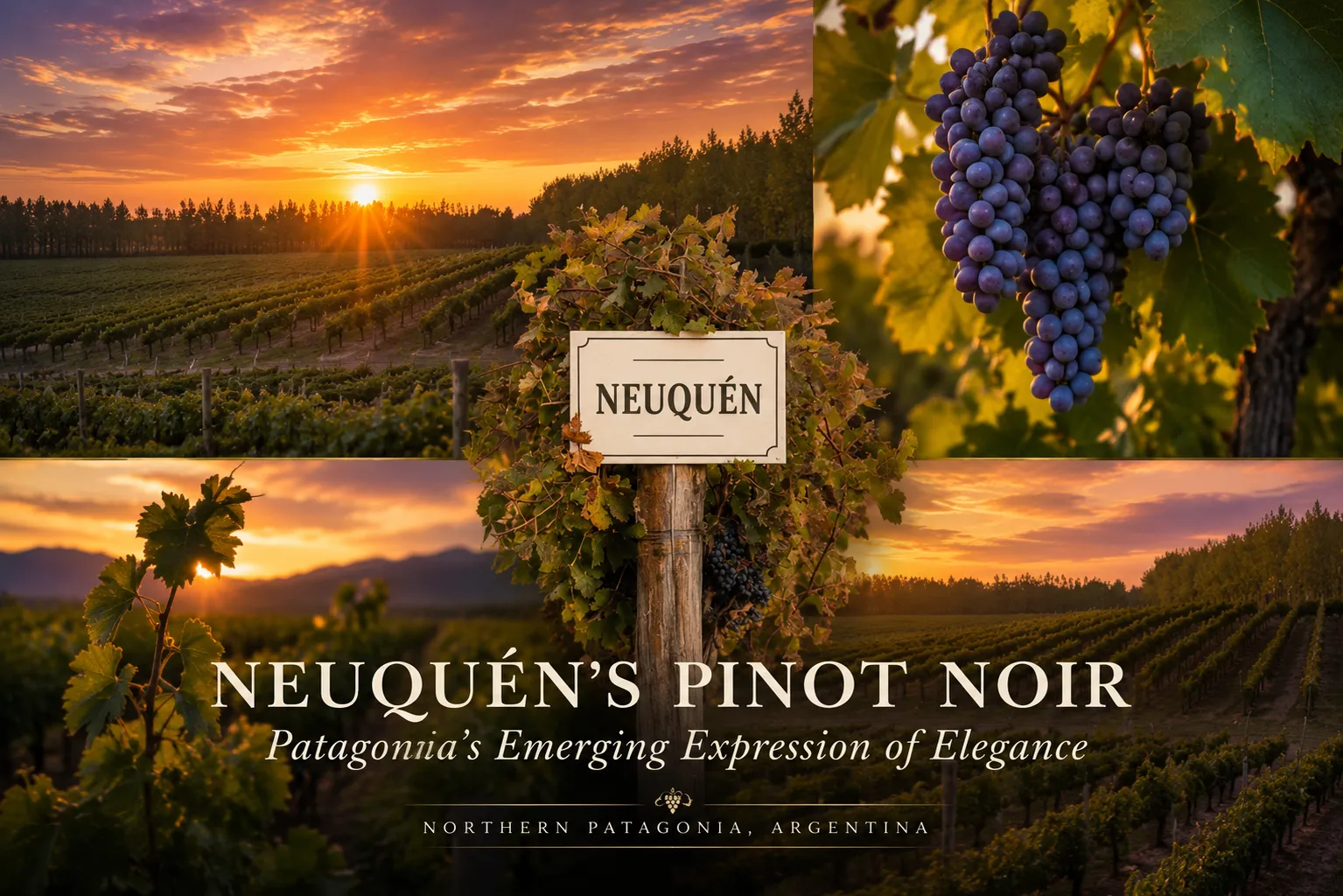
Patagonia occupies a special place in the global imagination. Mountains, glaciers, vast open spaces and remote landscapes have long defined this southern region of Argentina. Less well known is that Patagonia also hosts some of the world's southernmost wine regions.
In the province of Neuquén, more than 1,000 kilometres south of Buenos Aires, vineyards rise from an arid plateau where meltwater from the Andes makes viticulture possible. Over the last twenty-five years, this unlikely landscape has become one of Argentina's most distinctive homes for Pinot Noir.
Modern viticulture in Neuquén is remarkably young. The first vineyards were planted only in the late 1990s, yet the province has rapidly established itself as a leading region for Pinot Noir. What began as an ambitious experiment has evolved into a clear wine identity shaped by climate, landscape and the producers who believed this demanding variety could flourish in northern Patagonia.
Why Pinot Noir Thrives in the Steppe
Few grape varieties respond to place as transparently as Pinot Noir. In Neuquén, it found a combination of natural conditions particularly suited to its delicate character.
The vineyards sit in an arid environment with scarce rainfall and abundant sunshine. Warm, bright days are followed by cold nights. This marked diurnal temperature shift allows the grapes to ripen gradually while preserving freshness and natural acidity, an essential balance for a variety that easily loses finesse under excessive heat.
Water plays an equally crucial role. Viticulture here depends entirely on irrigation. The water that sustains the vines originates high in the Andes, feeding the rivers that cross northern Patagonia. For growers, access to Andean meltwater makes it possible to manage vineyard growth with remarkable precision. Unlike regions where rainfall dictates the season, producers in Neuquén can carefully manage water availability according to the specific needs of each parcel.
The persistent Patagonian wind is much more than scenery. It is a fundamental sanitary asset. Constant air circulation significantly reduces disease pressure, a major advantage for a variety sensitive to humidity and fungal diseases. This wind also contributes to the development of thicker grape skins and greater aromatic concentration, helping the wines retain the elegance and freshness that define the region.
Soils tell another part of the story. Much of the area features alluvial deposits formed by rivers descending from the Andes. These soils are generally poor in organic matter and offer excellent drainage, naturally limiting vine vigour and favouring smaller, concentrated berries. Combined with careful canopy management, they provide the foundation for wines that balance intensity with refinement.
Many of the conditions that producers elsewhere seek through extensive vineyard intervention are naturally present here. The variety still demands close observation and precise harvest timing, but the territory provides an exceptional starting point.
San Patricio del Chañar: The Heart of the Region
The modern history of Pinot Noir in Neuquén begins in San Patricio del Chañar, located about 55 kilometres north of the city of Neuquén. This vast plateau was completely absent from Argentina's traditional wine map when the first vines were planted in the late 1990s.
At the time, the landscape offered few clues about its future: steppe, wind and an endless horizon shaped by bardas and desert vegetation. Yet early pioneers recognised the potential of this arid climate, the well-drained soils and the high-quality irrigation water supplied by the Neuquén River.
Transforming this remote plateau into a wine region required long-term vision. Vineyards had to be planted from scratch, irrigation infrastructure developed and growers had to learn how Pinot Noir responded to this intense environment. They learned to manage canopy growth under strong sunlight, protect bunches from excessive exposure and identify harvest windows that often last only a few days.
The result was not an imitation of Burgundy or any other established region. Instead, the wines revealed a distinct Patagonian identity. Today, San Patricio del Chañar is home to wineries such as Familia Schroeder, Malma and Patritti, alongside producers exploring different interpretations, from fresh, fruit-driven styles to complex, parcel-selected, oak-aged wines.
A Territory Still Being Discovered
San Patricio del Chañar represents the birthplace, but it is no longer the only chapter in the story. Neuquén's viticultural map continues to expand, raising fresh questions about how Pinot Noir expresses itself across different landscapes.
Along the Limay River, vineyards benefit from conditions that differ subtly from those found in El Chañar. Meanwhile, projects in the Chimehuín valley and areas closer to the Andes are beginning to reveal the influence of altitude, cooler temperatures and mountain environments.
The Andean region itself offers exciting possibilities. Places such as San Martín de los Andes, Meliquina and other mountain valleys remain largely unexplored, yet their climatic conditions naturally attract growers interested in extreme cool-climate viticulture.
Further north, in Chos Malal and the Nahueve valley, pioneering experiences are contributing to a broader understanding of the province's diversity. Even in the central plateau, near Plaza Huincul, recent plantings have produced promising early results with Pinot Noir, suggesting that the variety may find a distinctive expression in the heart of the Neuquén steppe.
The Character of Neuquén Pinot Noir
Over the years, Neuquén's Pinot Noir has developed a recognisable personality. While each winery interprets the variety differently, certain characteristics appear repeatedly in the glass.
Fresh red fruit, especially cherry, raspberry and wild strawberry, often provides the first impression, sometimes accompanied by delicate floral notes. However, as these vineyards age and producers refine their work, a more complex dimension begins to appear.
Depending on the site and vinification, subtle notes of dry herbs, spice, earth, forest floor and wild mushrooms frequently emerge. These earthy, savoury nuances are fascinating because they establish a natural bridge between the wine and the culture of northern Patagonia, where seasonal mushroom gathering in Andean forests is an integral part of local gastronomy.
On the palate, these wines favour balance over power. Their appeal lies in their freshness, tension, fine tannins and an elegance that invites another sip rather than demanding attention through sheer concentration.
Pinot Noir at the Patagonian Table
In Neuquén, Pinot Noir has found a natural place alongside regional cuisine, a gastronomy where the quality of the raw ingredient matters more than elaborate preparation.
A trout caught in cold Patagonian rivers and simply grilled over an open fire offers a memorable pairing. The wine's freshness cuts through the richness of the fish, while its subtle savoury notes complement the dish without masking it.
Wild mushrooms gathered from Andean forests provide another compelling combination. Whether served in risottos, fresh pasta or contemporary mountain cuisine, mushrooms reveal one of Pinot Noir's classic affinities, resonating naturally with the earthy dimensions of the wine.
Further north, the renowned Chivito del Norte Neuquino PDO offers a deeply authentic expression of place. Raised under traditional transhumant systems, these young goats produce delicate, flavourful meat. Prepared simply over a wood fire, they find an exceptional companion in Pinot Noir, whose freshness and fine tannins respect the delicate nature of the meat.
Patagonia's long tradition of smoked foods, including trout, venison and artisanal cheeses, also highlights the wine's versatility. The acidity refreshes the palate while the earthy undertones align naturally with smoke profiles. This culinary identity extends to Araucaria pine nuts, known locally as piñones, harvested for centuries in Andean forests and deeply connected to Mapuche culture. In mountain cuisine, they inspire dishes that pair beautifully with the variety.
Premium Patagonian beef and locally raised Wagyu reveal another side of Neuquén Pinot Noir. While these meats are often associated with more powerful reds, reserve-style Pinot Noir can offer enough structure and depth to accompany richly marbled cuts while preserving freshness throughout the meal.
Wine, Landscape and Experience
Understanding Neuquén Pinot Noir through tasting notes alone tells only part of the story. Wine tourism has become a crucial dimension of the province's identity.
In San Patricio del Chañar, vineyard lunches and tastings take place where the desert-like steppe meets immense skies, and the Patagonian wind reminds visitors that nature remains in command. Further west, the experience shifts as rivers, forests and alpine landscapes dominate, suggesting a very different face of Neuquén viticulture.
Wine here does not exist in isolation. It belongs to a larger narrative of local food, landscapes and communities. Sharing a bottle of Pinot Noir as evening light fades across the steppe or while snow lingers on distant mountain peaks makes the wine part of a broader, quiet and clear experience of place.
Sustainability and Ageing Potential
The dry climate and constant wind provide an inherently healthy environment. Growers face fewer fungal challenges, allowing for precise viticulture with fewer phytosanitary interventions, a critical asset for producers committed to sustainable management.
While many wines are crafted for immediate freshness, the region's best examples demonstrate an impressive capacity to evolve in the bottle. Over time, primary fruit aromas give way to complex notes of dried herbs, forest floor and spice. As vineyards mature and producers refine their understanding, the cellaring potential of Neuquén Pinot Noir is becoming one of the region's most intriguing attributes.
Looking Ahead
Pinot Noir arrived in Neuquén barely twenty-five years ago, a brief moment in the history of wine. Yet it has already become one of the clearest expressions of the province's identity.
Much remains to be discovered. New vineyards continue to appear, new landscapes are being explored and each harvest adds fresh understanding to a territory that is still defining itself.
Perhaps that is what makes Neuquén Pinot Noir so fascinating. It is not a finished story. It is a wine region still being written, vintage after vintage, by growers, winemakers and a landscape that continues to surprise those willing to look beyond the obvious.
Neuquén Pinot Noir at a Glance
- Production: Neuquén is Argentina's second-largest Pinot Noir producing province.
- Surface: Pinot Noir accounts for approximately 14.5% of Neuquén's total vineyard area.
- History: Modern viticulture in the region began in the late 1990s.
- Main hub: San Patricio del Chañar remains the heart of production, although new valleys are actively emerging.
- Identity: The variety has become a signature wine and a leading expression of northern Patagonian terroir.
Further reading
- Neuquén Wine Regions in Argentine Patagonia
- Patagonian Wine Regions and Landscape
- Territory-Based Sommelier
- Why Patagonia is finding its place in a changing Pinot Noir market — The Buyer
- Back to blog
Share this article: sergiolandoni.com.ar/en/neuquen-pinot-noir.html